Live from Davos 2026: What to know on Day 4
More about the meetingDonald J Trump at Davos 2026
Forum live blog team
Elon Musk on space, robots, energy and optimism
Join us for a conversation with Elon Musk, the engineer and entrepreneur behind several industry-defining companies.
The founder and CEO of SpaceX, CEO and product architect of Tesla, and owner of social media platform X will sit down with Larry Fink, Chair and CEO at BlackRock and Interim Co-Chair of the World Economic Forum.
The conversation started with Fink asking Musk about the use of AI on robotics, on space, on energy, "all at the same time".
"When you look across those efforts, what do they have in common from an engineering standpoint?"
Multiplanetary life
Musk launched straight into an explanation of the rarity of life and consciousness and said, "if that's the case, then we need to do everything possible to ensure that the the light of consciousness is not extinguished because we're effectively...a a tiny candle in a vast darkness, a tiny candle of consciousness that could easily go."
That's why it's important to make life multiplanetary, he said.
He spoke about "full re-usability" for Starship - which will mean the cost of access to space will drop by a factor of 100 - using the analogy of a single-use aircraft.
Abundant Future with AI and robots
He thinks there will be a scenario where ageing can be reversed. He also said that "everyone will have a robot" and there'll be an "abundance for all", solving poverty and giving everyone a high standard of living.
"Humanoid robotics will advance quickly."
Energy
He thinks later this year, we'll be producing "more chips than we can turn on" - but highlighted that China is well ahead in renewable energy - so that ratio changes.
The amount of solar energy required to power the US would take up a "very small" percentage of the area of land across the nation, he added.
And then explained, "it's really all about the sun" and said he'd be launching solar powered satellites with Space X: solar energy in space is five times more efficient.
Self-driving cars
"A solved problem".
AI
By 2030 - "AI will be smarter than all of humanity collectively". He foresees building solar-powered AI data centres in space and said it would be the lowest cost place to put them due to very efficient cooling.
He concluded by saying that he's been deeply inspired by science fiction and encourages people to be optimistic about the future. Ending on a lighter note, he quipped, "it's better for your quality of life to be an optimist and wrong than a pessimist and right".
Stay up-to-date with Davos 2026 daily live blogs
Music and conversation with Yo-Yo Ma
World-renowned cellist Yo-Yo Ma took to the stage in our Congress Hall for a mix of music and conversation with Aulani Wilhelm, CEO, Nia Tero; Bryan Stevenson, Executive Director, Equal Justice Initiative; and Christine Lagarde, President, European Central Bank.
Between the various musical performances, Ma turned the floor to his three friends for what ended up being an incredibly moving, deeply personal conversation — including questions from people in the audience — on everything from how they handle crises, to the importance of tolerance, to our connection with nature.
“The fact you’re able to be vulnerable in front of all of us is a great lesson,” Ma said in response to some of the answers, a sentiment echoed by a member of the audience, part of the Global Shapers Community. “This is exactly what we need right now,” she said. “You are not just showing us your emotions, you are showing us your strength. You are brave to be so open.”
Watch the session below to see the full performance and conversation.
Lessons from Saudi Arabia's Vision 2030
Saudi Arabia’s Vision 2030 aims to create a vibrant society, thriving economy and an ambitious nation.
Now in its third and final phase of execution, this session explored the lessons learned, including the need to stick to long-term plans.
In a fragmented world, one way to maintain trade is to become a stronger economy.
”The participants questioned whether the world has entered a new phase, and with this, whether governments are thinking differently. Mohammed Al-Jadaan, Minister of Finance of Saudi Arabia, argued that “we’ve been in it for some time, but are only slowly realizing it”.
Noubar Afeyan, Founder and Chief Executive Officer, Flagship Pioneering, argued that COVID created a “pandemic of chaos”, suggesting that “everything has been a mess since then”. He added, however, that “uncertainty opens up opportunity”.
It was agreed that “absolute uncertainty is now the norm”. In light of this, Faisal Alibrahim, Minister of Economy and Planning of Saudi Arabia, suggested that the role of policy-makers is to provide a predictable environment, with this being the goal of Vision 2030.
Ajay S. Banga, President, World Bank Group, outlined the benefits of Vision 2030, revealing that “We’re watching a revolution going on, and I’m a big admirer of it.”
Also speaking were Jennifer Johnson, Chief Executive Officer, Franklin Templeton and Joumanna Bercetche, Anchor, Bloomberg News.
Catch up here.
Elon Musk on space, robots, energy and optimism
Join us for a conversation with Elon Musk, the engineer and entrepreneur behind several industry-defining companies.
The founder and CEO of SpaceX, CEO and product architect of Tesla, and owner of social media platform X will sit down with Larry Fink, Chair and CEO at BlackRock and Interim Co-Chair of the World Economic Forum.
The conversation started with Fink asking Musk about the use of AI on robotics, on space, on energy, "all at the same time".
"When you look across those efforts, what do they have in common from an engineering standpoint?"
Multiplanetary life
Musk launched straight into an explanation of the rarity of life and consciousness and said, "if that's the case, then we need to do everything possible to ensure that the the light of consciousness is not extinguished because we're effectively...a a tiny candle in a vast darkness, a tiny candle of consciousness that could easily go."
That's why it's important to make life multiplanetary, he said.
He spoke about "full re-usability" for Starship - which will mean the cost of access to space will drop by a factor of 100 - using the analogy of a single-use aircraft.
Abundant Future with AI and robots
He thinks there will be a scenario where ageing can be reversed. He also said that "everyone will have a robot" and there'll be an "abundance for all", solving poverty and giving everyone a high standard of living.
"Humanoid robotics will advance quickly."
Energy
He thinks later this year, we'll be producing "more chips than we can turn on" - but highlighted that China is well ahead in renewable energy - so that ratio changes.
The amount of solar energy required to power the US would take up a "very small" percentage of the area of land across the nation, he added.
And then explained, "it's really all about the sun" and said he'd be launching solar powered satellites with Space X: solar energy in space is five times more efficient.
Self-driving cars
"A solved problem".
AI
By 2030 - "AI will be smarter than all of humanity collectively". He foresees building solar-powered AI data centres in space and said it would be the lowest cost place to put them due to very efficient cooling.
He concluded by saying that he's been deeply inspired by science fiction and encourages people to be optimistic about the future. Ending on a lighter note, he quipped, "it's better for your quality of life to be an optimist and wrong than a pessimist and right".
Want growth? Prepare for dilemmas
The global economy is generating historically weak levels of growth; this session explored the trade-offs involved in boosting it.
International Monetary Fund Managing Director Kristalina Georgieva was asked by Senior Fellow at Stanford University’s Hoover Institution Niall Ferguson about growth projections from the US that seem to outpace the IMF’s own forecast for that region.
Georgieva said she’s always happy when economies exceed expectations. “Bring it on, it is good for the world economy,” she said.
Georgieva observed that the IMF’s recently increased global growth forecast for this year brings the figure right back to where it was before “Liberation Day” in April, when the US announced a raft of punitive tariffs (and economists feared the worst).
The resilience demonstrated since then can be chalked up to a surprisingly agile and adaptable private sector, Georgieva said.
AI could yet ramp up productivity, she said. It could even lift global growth above where it was prior to the COVID-19 pandemic.
But here's a very prominent growth dilemma: 40% of jobs globally are going to be impacted by AI over the next couple of years, Georgieva said, either by being transformed or eliminated. In advanced economies the figure is 60%. Are we ready for that?
The answer, according to Georgieva: “no.”
The IMF itself is not immune to this trend, she said – it’s gone from 200 translators to just 50.
Watch the session here.
All geopolitics is local. What does it mean?
In a world where foreign policy is shaped as much by local expectations as by international strategy, today’s session asked a simple but sharp question: When geopolitics starts at home, what does cooperation look like?
Speakers from across foreign ministries and the private sector explored how domestic pressures — from political accountability to economic expectations — are reshaping diplomatic priorities and international collaboration.
“The main geopolitical challenge ahead of us that has local implications is the growing conflictuality between the US and China that threatens to drag us into this conflictuality or to pick sides in ways that countries like France, but also other countries in Europe, are not willing to do,” said Jean-Noël Barrot, Minister for Europe and Foreign Affairs of France.
The session also examined how leaders are reconciling constituency demands with long-term cooperation on security, technology, energy and supply chains.
Nir Bar Dea, the CEO of Bridgewater Associates, stated that the “world is transforming from a globalization macro framework to a different one,” asking how the world's major powers will handle the transition when it's happening at the “same time that they're all battling a must-win technological battle.”
"The economic damage is huge": How can we prevent wildfires?
From Southern Europe to the US West Coast, wildfires are growing more frequent, intense and costly, inflicting tens of billions of dollars in losses each year.
But well-managed forests and new technologies can help to resist, rather than fuel the fires. On the panel were: Mark Moffat, CEO, Industrial Financial Systems, IFS AB; Celeste Saulo, Secretary-General, World Meteorological Organization (WMO); Josef Aschbacher, Director-General, European Space Agency (ESA); Francois-Ghislain Morillion, Co-founder, Chief Executive Officer & Sourcing Director, VEJA; and it was moderated by Aileen S Lee, President, Gordon and Betty Moore Foundation.
"Wildfires are not local or individual phenomena; these are systemic problems," said Saulo. The climate crisis is fueling more severe wildfires, which produce carbon emissions, which cause further warming, known as the fire feedback loop.
On the scale of this issue, Moffat remarked: "The economic damage is huge, the disruption in relation to infrastructure is just off the scale". From his perspective, this makes forest management key, making prevention a priority.
The panel highlighted Earth observation (EO) technology as essential for preventing wildfires. EO satellites use infrared sensors to detect heat signatures, providing near real-time tracking of active wildfires, enabling faster and smarter response. "You've dealt with the issue before it even arrives," said Moffat.
Our goal is for nobody to be taken by surprise by a wildfire.
”Closing out the session, Saulo emphasized the importance of having open datasets that multiple actors can use and act upon. A crucial element of this is sharing wildfire data with healthcare systems, so those impacted can be appropriately treated.
Watch the session on-demand here.
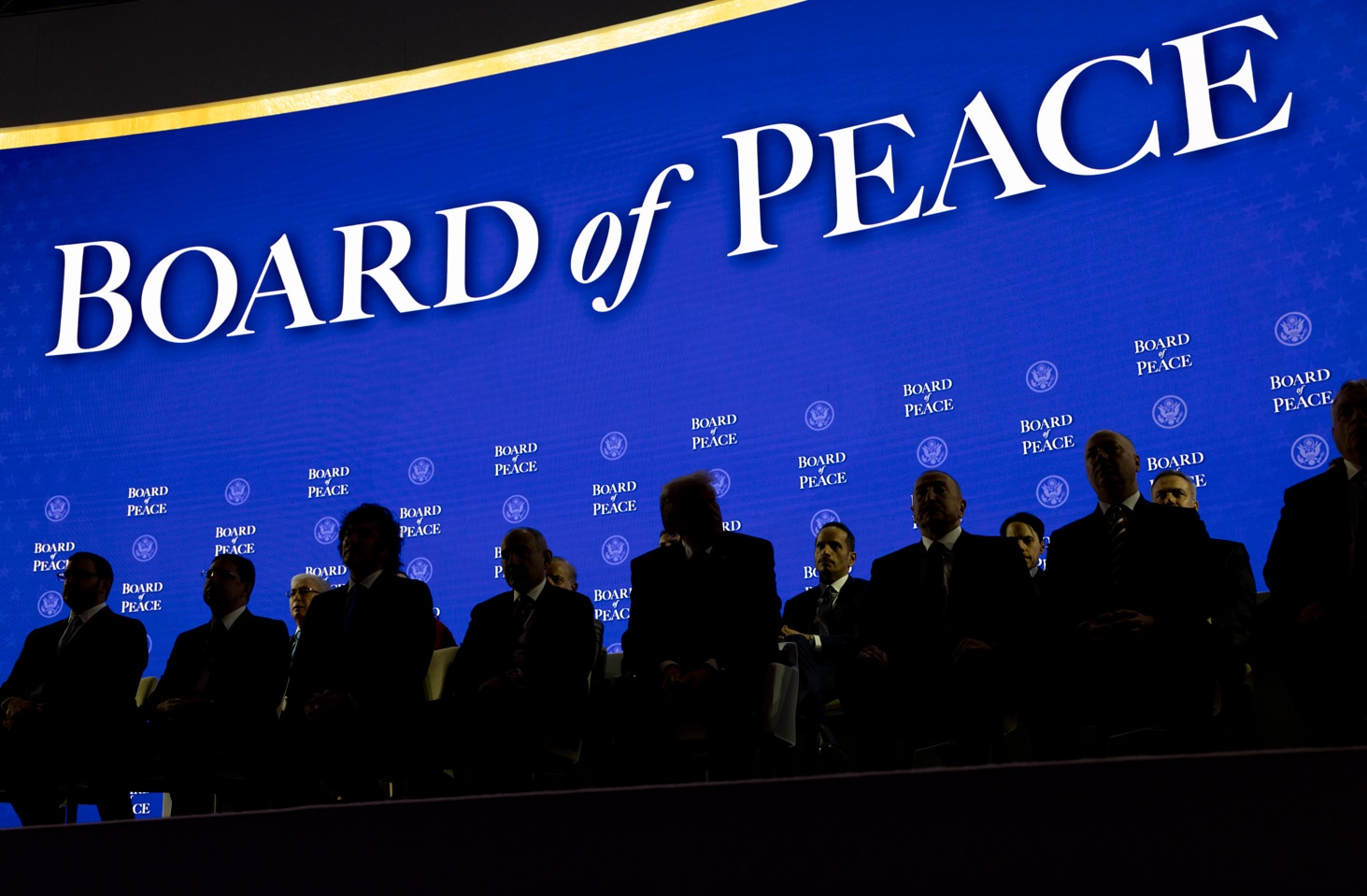
Board of Peace announcement and Gaza reconstruction plan
The US-hosted Peace event was organized by the US Government and took place on the margins of the Annual Meeting in Davos. It included a significant focus on peace and recovery in Gaza.
The Forum facilitated the session by providing space at the Davos Congress Centre.
Why the WTO is 'far from dead'
Free trade is giving way to a new era of managed trade, where governments increasingly use tariffs, export controls, industrial policy and friendshoring to protect domestic markets and secure supply chains.
This session ‘Many Shapes of Trade’ invited trade leaders from around the world to debate what this emerging trade system will look like and how it can balance security with openness.
The WTO is "far from dead," said Ngozi Okonjo-Iweala, Director-General, World Trade Organization (WTO).
"I dream about the exciting things happening in trade... Digital trade is so exciting and is happening at a fast pace."
In Africa, in South Africa, women and young people are trading digitally and reaching customers across the globe, she says. Services trade is growing at 4%. Green trade is now $2 trillion.
I see an organization that can seize those opportunities. But we have to move with the times.
”"We have many things not working: the way we make decisions, we need variable geometry, we need plurilateralism, the ability to be nimble and move fast."
The panel included: Peter Kyle, Secretary of State for Business and Trade and President of the Board of Trade, Department for Business and Trade of the United Kingdom; Majid Al-Kasabi, Minister of Commerce, Ministry of Commerce of Saudi Arabia; Vas Narasimhan, Chief Executive Officer, Novartis; Yeo Han-koo, Minister of Trade, Ministry of Trade, Industry and Resources of the Republic of Korea; and is moderated by Michael Froman, President, Council on Foreign Relations.
Narasimhan said the pharmaceutical industry is seeing "the biggest disruption" in history. Under tariffs, it has shifted to production in countries - it’s a significant cost. Global clinical trials are also being impacted.
“Trade is shifting from fair trade to a managed and maybe a rule-driven model,” said Al-Kasabi. Saudi Arabia can become a "connector economy". On the WTO reform, he said it's not perfect but everyone needs to be part of the solution. The whole world is shifting towards protectionism, he adds, and we’re seeing regional globalization. "We need a new trade book."
The trade system that was built has lifted 1.5 billion people out of poverty, it’s created jobs, but also jobs have been lost, said Okonjo-Iweala. "The rules have done their part... But we have seen a rise in protectionism."
You can see more protectionist measures even among the G20, she added. In the environment now when countries are saying we have to fight for our national interests, what measures can we take, what are the guardrails?
Yeo lists the ways Korea is competitive, including in shipbuilding. On whether the country will join the Comprehensive and Progressive Agreement for Trans-Pacific Partnership (CPTPP), he said "diversification" is Korea's aim - and they are still preparing.
In October 2025 began its first World Trade Organization (WTO) Trade Policy Review since leaving the EU. "We haven't turned our back on the EU," he said, listing the trade deals the UK has made with different countries. "There's a lot of complementary out there, and we're just exploring everything." He says the UK is the "case-book study" of an open, free-trading nation, committed to rules-based trading.
Tune into the session here.
Special Address by Volodymyr Zelenskyy, President of Ukraine
A special address by Volodymyr Zelenskyy, President of Ukraine.
He spoke about Russian aggression against Ukraine, the international justice system, and security guarantees for the post war scenario.
He mentioned the need for a European "coalition of action" and said "no security guarantees work without the US". He also called for united armed forces for Europe and questioned NATO's readiness to respond to aggression.
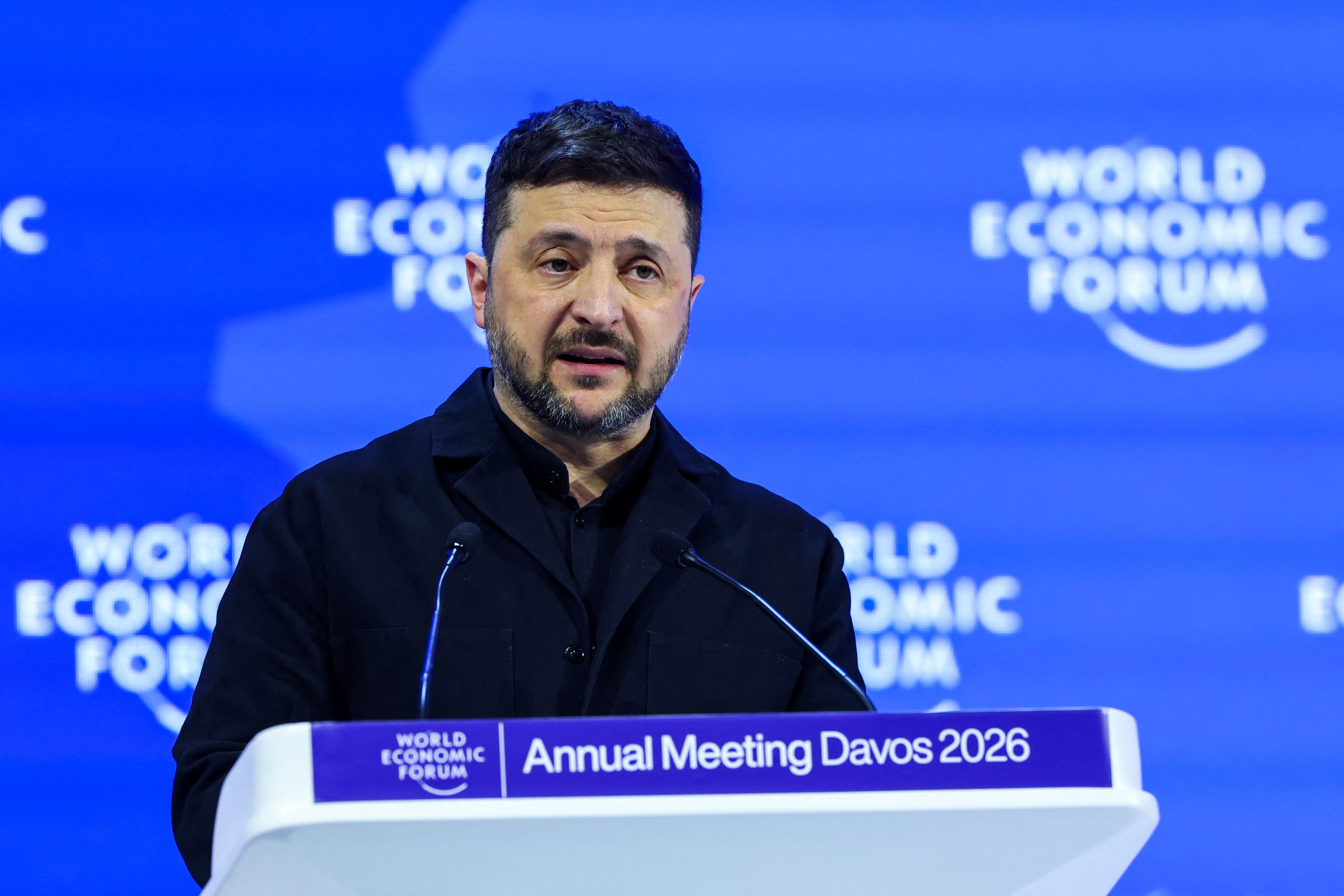
He referred to the avoidance of certain issues between world leaders and said "Europe remains a beautiful but fragmented kaleidoscope of small and middle powers".
He mentioned a meeting of the European Council tonight and said fast-moving events on Greenland are moving "too fast for Europe". But said, "Europe must build a better world" and act together.
The address was received by a standing ovation.
Read a transcript here.
"The hardest advances in robotics are behind us". Here's what's next
Self-steering cars, digital therapists and algorithm diagnoses. Autonomous systems are transforming sectors and day-to-day life.
In this session, experts on physical AI walked us through what's next for autonomous systems. The panel included: Daniela Rus, Director, Computer Science and Artificial Intelligence Laboratory, Massachusetts Institute of Technology; Jake Loosararian, Co-Founder and Chief Executive Officer, Gecko Robotics; Shao Tianlan, Founder and Chief Executive Officer, Mech-Mind; and was moderated by Jamie Heller, Editor-in-Chief, Business Insider.
Rus highlighted how robots are freeing up time for port workers: "We have entire fleets of robots that operate 24/7, moving shipping containers without human intervention." Yet substantial room for improvement exists, Rus said: "We still have challenges with manipulation, with handling the world. To make progress, we need better sensors, as our robots lack the skin-like sensing that humans do."
Teleoperation — remote control of machines or robots by a human operator — is still essential for many robots, meaning fully autonomous robotics is still a number of years away, Loosararian explained.
To bring autonomous robots to everyday life, cost must come down, according to Rus: "I can give you a robot that can wash your dishes or fold your clothes, but it might cost you half a million dollars."
A question from the audience raised the question of consciousness for robots. Shao explained that an important next leap in this area is getting autonomous systems to calculate risk, detect abnormalities and make judgement calls, just as a human would.
The session concluded with a sense of hope for the future and positive reflections on the last decade of progress for robotics, as Shao explained: "The hardest advances in robotics are behind us."
Watch the session here.
Special Address by Prabowo Subianto, President of Indonesia
Prabowo Subianto, President of Indonesia, took office in October 2024 and now leads the world’s fourth-most populous country at a time of shifting regional and global dynamics.
In his special address at Davos, the President spoke about how "peace and stability are our most valuable assets…and are the ultimate prerequisites for growth and prosperity," as well as how Indonesia can prepare its economy for the industries of the future.
You can rewatch President Subianto's full speech below and read the transcript here.
What's next for Venezuela?
Just weeks after former president of Venezuela Nicholas Maduro was forcefully removed from power by the United States, an expert panel of academics examined one of the most volatile political and economic flashpoints in Latin America: Venezuela’s future trajectory amid rapid political shifts, economic strain and global diplomatic tensions.
"There are three prerequisites for a recovery of foreign investment in Venezuela: political stability, political stability, political stability," said Jeffry A. Frieden, Professor of International and Public Affairs and Political Science at Columbia University.
Meanwhile, Ricardo Hausmann, Founder and Director of Growth Lab at Harvard University, explained that no recovery can happen without protecting rights for the Venezuelan people, noting that it was a "lack of rights that collapsed the economy."
Davos Kick-off for FIFA World Cup 2026
The FIFA World Cup is already the biggest show on Earth, but the next one is going to be historic. For the first time, 48 teams will compete across three countries — Canada, Mexico and the US — starting this June.
FIFA President Gianni Infantino and football legends Alessandro Del Piero and Arsène Wenger joined leaders in Davos to talk about what makes the beautiful game so special and what to expect from the tournament this summer.
For Infantino, football is more than just a sport: it is a “magic instrument” that brings people together. At the same time that there was talk about building walls between Mexico and the US, the two countries, along with Canada, were “working together for a joint bid” he told participants. “There is nothing even close to what football does.” And that’s not even to mention the real economic impact of the sport, as he highlights in this clip:
After Infantino’s opening remarks, Del Piero took to the stage and spoke movingly about the role that football played for him growing up, recalling memories of celebrating Italy’s World Cup victory with his family — something he later went on to do as a player, in 2006.
Wenger, who now works as Chief of Global Football Development at FIFA, added that wherever he travels in his current role, he sees with his own eyes the unifying power of the sport. “I travel all over the world, and everywhere I go, people talk about football,” he explained. “There’s a feeling that we are all together.”
Watch the full session to hear more of their conversation, which touched on everything from the importance of failure to the pure joy sport can bring in an increasingly volatile world.
Parenting in the digital age
Parenting in the digital age has created a new challenge: both parents and children are often more connected to their screens than to each other.
For Jonathan Haidt, Professor of Ethical Leadership at NYU, this shift has in part come about because of the demands of modern life. “Women are working more and more outside of the home, but they’re also spending more and more time with kids, because we have this hands-on model, so now what happens is, they’re incredibly stressed, and they discover: ‘Just give the kid the device! He’s happy, you’re happy, we all have peace,” he explained to participants in a session about the challenges of parenting today. “We all discovered that the iPhone is an incredible babysitter, but it’s about the same as giving your kid morphine — not a good idea to do it continuously throughout their childhood.”
It’s not such a good idea not only because of the well-documented risks of excessive screen time for children — it can affect linguistic skills, emotional development, cognitive abilities. It’s also because of the opportunity cost, said Rachel Botsman, Author, Artist and Trust Expert. When children spend all their time in a digital world, they miss out on all the real-world experiences that shape them into well-rounded adults. “They don’t have the opportunities to develop self-trust.”
But while parents are still wrapping our heads around the pros and cons of social media bans, and whether smartphones should be allowed in schools, Haidt thinks that the stakes have already been raised, thanks to AI. He believes the technology poses a threat not just to children’s attention spans but also to their ability to form secure attachments with their caregivers, something that child development experts believe influences everything from resilience to emotional regulation. “We let these companies hack our attention, with devastating cognitive and emotional results, now we’re letting them hack our attachment. And that will be catastrophic for humanity,” he argued.
Becky Kennedy, CEO and Founder of Good Inside — and better known as Dr Becky to her millions of Instagram followers, added some extra context to really emphasize what is at play here: “Attachment is how kids learn trust, but it’s also the blueprint you take into adulthood for the relationships you seek out,” she explained. If our earliest relationships are with an AI cuddly toy, a flawless, infallible computer, “you can think about the rage someone will feel in a relationship with a human who does get things wrong, who rejects them once in a while, who says, I don’t know about that,” she said.
To follow the conversation and learn about some proposed solutions, watch the session below.
Defying cognitive atrophy
Is AI dulling our minds? A recent paper from MIT raises some concerns, with researchers finding that students who relied on tools like ChatGPT had lower brain engagement than others. While the paper has yet to be peer reviewed, it raises important questions related to how we redesign education to ensure AI enhances rather than atrophies human cognitive capabilities.
“This is one of the most important subjects of the coming years,” said William J. Hague, Chancellor of Oxford University, in his opening remarks on a session on the topic.
In a lively session, panellists and participants were split on how to approach the issue. For Carl Eschenbach, CEO of Workday, and Omar Abbosh, CEO of Pearson, “the genie is out of the bottle” — an expression both panellists used on different occasions during the discussion. In other words, whether we like it or not, AI is here, and if we want to ensure young people are one day ready for the world of work, they need to learn how to use it effectively.
But for Anna Frances Griffiths (Vignoles), Director of the Leverhulme Trust, we need to think about things differently when it comes to young children. “We’re up against evolutionary biology: All species like to conserve energy… Learning takes effort; naturally people will tend to take the easy route,” she said. Now that’s all well and good if you’re an adult, she pointed out. “But as a child, if you don’t get a chance to develop these cognitive skills, to develop the neural pathways, we’re in trouble.”
Jonathan Haidt, Professor of Ethical Leadership at NYU Stern School of Business, who has written about the risks of technology in childhood, took a different stance. Although not taking part in the session as a panellist, when the floor was handed over to participants to share their thoughts, he was unequivocal in his remarks: “AI is coming into childhood, and it’s not as though we don’t have a precedent for this,” he warned. “Social media came into childhood…and the result is the greatest destruction of human capital in history.” His comments were greeted with a round of applause from other participants.
Watch the session in full below.
What's next for the US economy — and American workers?
Predictions of a US recession have come and gone, yet the economy defied forecasts and continues to grow. However, as the country benefits from rapid innovation, energy independence and access to capital, it also faces record deficits, economic inequality and distrust in institutions.
In this session, panellists explored whether the US will continue to outperform, or whether this is a temporary economic edge, and examined how AI is impacting American businesses and workers.
“We have seen consistently that the economy is performing really well overall,” said Charles Scharf, Chairman and CEO of Wells Fargo. “But at the same time, when you look at who's doing well and who's not doing well, it's very, very uneven.”
On AI and its impact on the job market, Joe Ucuzoglu, the Global CEO of Deloitte, noted that “there will absolutely be labour market displacement.” However, like in prior waves of technology changes, there will also be the “creation of new jobs, many of which people could have never imagined in the moment,” Ucuzoglu added.
Scharf added that as the labour market develops, he has found that "the people who are the most successful, are the people who learn the most as they go through higher education, and they learn the most about a broad range of topics."
Town Hall — Dilemmas around Ethics in AI
As artificial intelligence becomes more embedded in everyday life, the questions it raises are no longer just technical or economic. They are philosophical, social and deeply human.
Like, how do we preserve moral agency as autonomy shifts to algorithms? And what defines personhood in an age where intelligence can be synthesized?
The session brought together voices that approach AI from very different angles, including Max Tegmark (Professor, Massachusetts Institute of Technology), Meredith Whittaker (President, Signal Foundation) and Rachel Botsman (Author and Trust Expert).
The panel debated on governance, accountability and whether existing frameworks are equipped to handle what's coming. The format allowed for audience participation and direct engagement with the dilemmas.
Watch the session here.
"Change in mindset" needed to end plastic pollution
"Economic systems favour linear business models", said Alfred Stern, CEO, OMV. "It’s lower cost to produce, use and dispose of items once. We need to close that circle".
In August 2025, negotiations for a global plastics treaty stalled once again, leaving the world without a clear path forward. Meanwhile, plastic pollution continues to pose growing challenges for climate, health and economies around the world.
Also on this panel were Jessika Roswall, Commissioner for Environment, Water Resilience and a Competitive Circular Economy, European Commission; Frank Tang Kui, Chairman and CEO, FountainVest Partners (Asia); Inés María Manzano, Minister of Environment and Energy, Ministry of Environment and Energy of Ecuador; José Manuel Ramos Horta, President of Timor-Leste, Timor-Leste Government; and it was moderated by Kelly Sims Gallagher, Dean, The Fletcher School, Tufts University.
When it comes to circularity, "we all need to have a change in mindset," said Roswall. One of the current barriers to this is cost, as consumers are hesitant to pay more for sustainable products, while many businesses are yet to scale circular business models to maintain profitability.
Watch the session back here.
Where are we on stablecoins?
Stablecoins are quietly moving into the financial mainstream. “We’ve seen a dramatic explosion in the use of stablecoin,” Wall Street Journal editor Gerard Baker told participants in a session in Davos.
What’s driven that growth and where is it going? Dan Katz, First Deputy Managing Director at the IMF, started by putting those figures into perspective: “In the context of the global financial system, $300 billion” — that’s the total market capitalization of stablecoins, according to recent estimates — is still very, very tiny,” he told participants.
But that figure belies its potential, other panellists pointed out. Take the example of the African continent, where access to banking and high inflation rates remain a huge issue. “1.5 billion people globally do not have access to a bank account, 650 million people on the African continent,” said Vera Songwe, Chairperson and Founder, Liquidity and Sustainability Facility. “With a smartphone, you have access to stablecoin, so you can actually save in a currency that is not exposed to the fluctuations of inflation and making you poorer,” she explained. “That’s a big contribution of stablecoin.”
Indeed, as Jeremy Allaire, Co-Founder, Chair and CEO at Circle, a payments technology company, noted, if anything, we’re seeing use cases proliferate beyond what was initially envisaged: “We’re seeing use grow in cross-border trade settlement; we’re seeing use grow in trade finance; we’re seeing the biggest e-commerce platforms like Stripe and Shopify adding USDC payment acceptance in their own platforms.”
That’s something that Siu Yat, Co-Founder and Executive Chairman of Animoca Brands, a digital assets company, thinks explains stablecoin’s huge takeup — and why, he thinks, that trend will continue to grow. In the countries where his company operates, for example, they saw mass adoption during COVID, when people were forced out of the traditional labour market and had to find alternative sources of income. “In places like the Philippines and Indonesia, there was basically mass adoption in places where they needed to make a virtual income.”
Watch the session in full here.
Ideas on the Move - Sabrina Dhowre Elba
What drives Sabrina Dhowre Elba?
Sabrina and Idris Elba are UN Goodwill Ambassadors for the International Fund for Agricultural Development (IFAD).
In this on-the-move interview, Sabrina says her motivation comes from challenging what we think we know, and carrying the voices of rural African communities into global spaces like Davos.
The Ideas on the Move team have been catching up with participants as they shuttle between meetings and sessions. Other voices include investor Ray Dalio, scientist Johan Rockstrom and economist Gita Gopinath. Stay tuned!
"The burden of disease is too high": How to prevent NCDs
Non-communicable diseases (NCDs) – such as cardiovascular disease, cancer and diabetes – account for 75% of global deaths, yet they are not a priority in the global health agenda.
The burden of disease is too high, said Mosa Moshabela, Vice-Chancellor and Principal, University of Cape Town: "Between 2011 and 2030, the world will spend more than $30 trillion tackling NCDs. Instead of incurring the expenses, we could be preventing them and investing that money more in prevention."
This session brought together voices from across the healthcare spectrum, including: Shamsheer Vayalil, Founder and Chair, Burjeel Holdings; Nancy Brown, Chief Executive Officer, American Heart Association; Johan Westman, CEO, AAK, to explore how we can harness place-based solutions to address the burden of NCDs.
The panel turned to food systems as a prevention for NCDs. Westman highlighted access issues to healthy food for many families: "What food is affordable, what food is available, what food do my kids like?" These are challenges parents face every day.
To get affordable and healthy food on the shelves for families, Westman emphasized the need for greater alignment between actors: "I think we need to find a way to get companies, policymakers and health recommendations to be a bit more in sync."
On the treatment side, one core challenge is a workforce shortage, Vayalil said: "We don't have enough workers to make sure that NCDs are not only treated in hospitals. It should be managed in schools, communities and sports also."
Watch the session in full here.
Open Forum: Beyond Earth - The Next Space Race
As we delve further into space, with private companies reshaping the landscape, we must answer this: how do we balance discovery with responsibility?
This Open Forum discussion included public and private sector space experts: Hélène Huby, Founder and CEO, The Exploration Company; Dylan Taylor, Chairman and CEO, Voyager Technologies, Inc; John Gedmark, CEO, Astranis; Samantha Cristoforetti, Astronaut, European Space Agency (ESA); Renato Krpoun, Head, Swiss Space Office, State Secretariat for Education, Research and Innovation (SERI) of Switzerland; and will be moderated by Lara Abrash, US Chair, Deloitte.
Catch up on the session here or below.
Much still to come: A Thursday Davos media roundup
A marquee Davos 2026 participant left some reassurance in his wake but also many questions. The media is parsing where things stand now on trans-Atlantic discussions that took place at the Annual Meeting, while focusing on other high points at the confab that can be carried forward.
“An alternative to simply rolling over.” The Canadian prime minister’s special address was a hopeful message that “middle powers” are not helpless. (The Conversation)
Fact-checking another special address that was rife with “bold statements.” (Euronews)
“A concept of a deal” emerges for Greenland at the Annual Meeting, and while details remain fuzzy markets like it very much. (CNBC)
“If there were agreements to be signed.” A central figure in negotiations over Ukraine’s future appears to be headed for the Swiss Alps. (Bloomberg)
“This is a different moment.” Why so much of the Davos oxygen has been sucked up by geopolitical crisis negotiations. (CNN)
Friedrich Merz: 'Our fate is in our hands - it's our responsibility to shape it'
The "calm and peace up here on the Magic Mountain is in stark contrast to a world whose old order is unravelling at breath-taking pace", said Friedrich Merz, Federal Chancellor of the Federal Republic of Germany, after an introduction by World Economic Forum President Børge Brende.
As Germany’s head of government since May 2025, Merz has focused his leadership on strengthening economic competitiveness, deepening strategic international partnerships, and navigating a complex geopolitical landscape.
The tectonic shifts the world is seeing have "the most profound ramifications for freedom, security and prosperity," he added.
We are not at the mercy of this new world order, though. "We do have a choice... We must face harsh realities and chart our course with clear-eyed realism."
Our power today rests on three pillars: our security, our competitiveness and our unity.
”Cooperation is essential: "Our greatest strength remains the ability to build partnerships and alliances among equals - based on mutual trust and respect."
Turning to the competitiveness, he said Germany can only lead the way in Europe by being economically strong: "Economic competitiveness and the ability to shape global politics are two sides of the same coin."
European competitiveness has been hindered by the excessive curtailment of entrepreneurial freedoms, he said. "We must reduce bureaucracy substantially in Europe."
"The single market was once created to form the most competitive economic area in the world, but instead we have become the world champion of over regulation."
A special summit of EU leaders will take place on 12 February to discuss a "modernized EU budget putting competitiveness, centre stage".
We want to have a fast, dynamic Europe.
”In closing, he returned to the theme of shaping the future: "Let us be inspired by what is maybe the most important lesson of enlightenment. Our fate is in our hands. It is in our responsibility and our freedom to shape it."
Watch the full speech below and read the full transcript here.
Conversation with Isaac Herzog, President of the State of Israel
The Israeli President Isaac Herzog joined Fareed Zakaria, host of Fareed Zakaria GPS on CNN, for a discussion.
He spoke about the geostrategic shifts in the region, the fragility of the Iranian regime, and prospects for the Board of Peace, assembling on the sidelines of Davos this week.
Other topics included the Abraham Accords, the potential for rapprochement with Saudi Arabia and Israel's forthcoming election year.
Watch the session here.
Conversation with Gavin Newsom, Governor of California
This morning in Davos, California Governor Gavin Newsom took the stage for a wide-ranging conversation with Ben Smith, the Co-Founder and Editor-in-Chief of Semafor.
Your 10-minute morning briefing for Day 4
Listen to our daily audio briefing to get a 10-minute download of the highlights coming up today.
Stacey Vanek Smith, co-host of the Bloomberg Businessweek podcast Everybody's Business, joins us, straight after watching President Donald Trump's address to the Annual Meeting.
Welcome to Day 4 of Davos 2026
Welcome to the fourth day of the World Economic Forum's Annual Meeting in Davos.
We're bringing you a rundown of what's happening on the ground, the key sessions to watch - with live snapshots, essential reading, and an inside track on the conversations that matter.
Here's a recap of what you may have missed.
And here are some of the key sessions today and notable speakers:
Where Are We on Stablecoins? at 10:15 CET
Venezuela: What Next? at 13:30 CET
An Honest Conversation on AI and Humanity at 14:30 CET
All Geopolitics Is Local at 16:15 CET
Town Hall: Dilemmas around Growth at 16:15 CET
Music and Conversation with Yo-Yo Ma at 18.30 CET
License and Republishing
World Economic Forum articles may be republished in accordance with the Creative Commons Attribution-NonCommercial-NoDerivatives 4.0 International Public License, and in accordance with our Terms of Use.
The views expressed in this article are those of the author alone and not the World Economic Forum.

Forum Stories newsletter
Bringing you weekly curated insights and analysis on the global issues that matter.
More on Forum in FocusSee all

Jaci Eisenberg
March 10, 2026


