In Africa, data centre demand has not yet overwhelmed electricity systems.
But demand is expected to grow from 0.4 gigawatts (GW) to 2.2 GW by 2030, according to McKinsey.
African countries can succeed in the AI era by planning power and digital systems together, and by treating data centres as strategic infrastructure.
Artificial intelligence (AI) development is often framed as a race for better algorithms, faster chips and bigger models. But behind every breakthrough there is a more basic requirement: reliable electricity.
The AI race is becoming a competition for power grids.
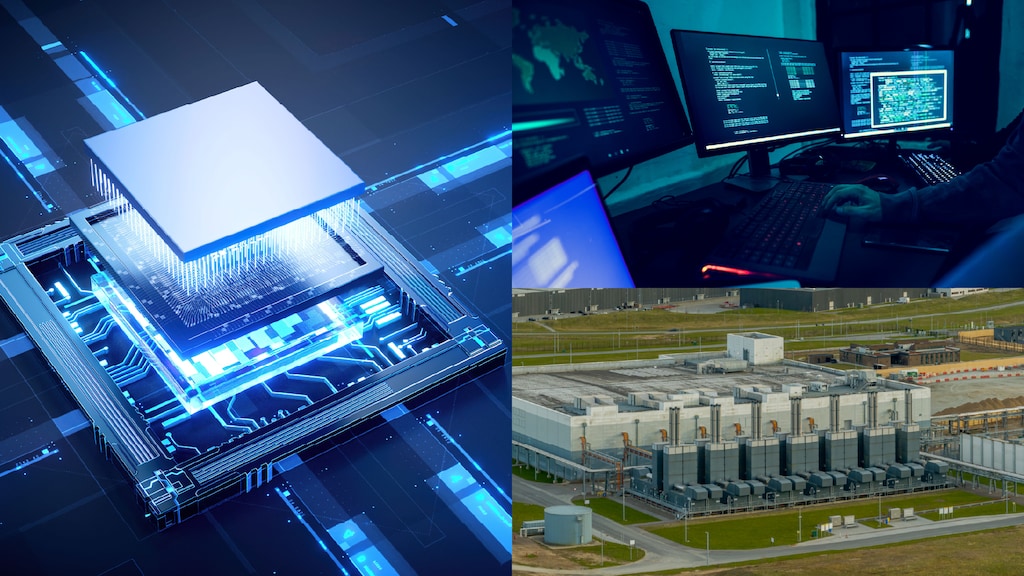
AI systems are trained and run from data centres whose dense processors, fast networks and cooling needs require far more resources than conventional infrastructure. Some data centres consume as much electricity as a small city. This places large, concentrated loads – or demand – on local grids, challenging the countries competing to host these systems.
In Africa, unlike other countries, data centre demand has not yet overwhelmed electricity systems. But while most African electricity systems were not built for hyperscale digital infrastructure, their grids can be adapted before AI-driven demand reaches the scale seen elsewhere.
Africa's data centre market is accelerating
Africa is still a small part of the global AI market, but its growth prospects are significant. McKinsey estimates that the continent’s demand for data centre capacity could rise from about 0.4 gigawatts (GW) today to between 1.5 and 2.2 GW by 2030. This would require $10-20 billion in construction investment.
Combined installed capacity across Egypt, Kenya, Morocco, Nigeria and South Africa is currently below 500 megawatts (MW) – less than France in 2024. But demand in these leading markets is expected to grow 3.5 to 5.5 times by the end of the decade, driven by cloud adoption, data sovereignty requirements and the movement of AI from experimentation into production.
Around 40% of African corporations are already experimenting with or implementing generative AI. And as those pilots across sectors including telecommunications, banking and public services move into production, demand for locally hosted computing capacity will intensify.
These data centres will need dependable electricity, transmission, land, cooling resources and a stable investment climate.
Lessons from other AI markets
More mature AI markets have already shown what happens when digital infrastructure outpaces the grid. A large hyperscale campus could require 100 MW or more of power to support AI and cloud infrastructure. Projects also often cluster together, creating unanticipated demand spikes.
Large power sources can take several years to procure, but the risk is not only insufficient generation. Power must also reach the sites where data centres are built. New lines and substations typically take far longer to permit and construct than the facilities they serve.
Governments and regulators are in more mature markets are already addressing these issues. In Ireland, data centres already accounted for about 22% of metered electricity consumption by 2024. Connection restrictions introduced in 2021 were replaced by a new national policy in December 2025, which required proposed facilities to address their grid impact.
Elsewhere in Europe, Amsterdam in the Netherlands has banned new data centres and expansions until at least 2030. This shows how delayed planning can force regulators into costly interventions.
Africa does not have to repeat these mistakes because most of its projected AI demand has not yet materialised, so what can its countries do now to succeed in the AI economy?
Planning power and digital infrastructure together
The World Bank argues that infrastructure investments generate the greatest returns when energy, digital and transport systems are planned together. Electricity makes digital infrastructure productive, while digital systems improve how networks are run, so cross-sector investment can yield benefits beyond individual projects.
This matters most for economies under tight fiscal constraints. Their governments must identify where coordinated investments in generation, transmission, fibre optics and tech skills create the greatest value.
This planning should begin before developers file connection requests, with prospective AI zones identified based on available power, grid, fibre and water resources, and proximity to demand.
Data centres as strategic infrastructure
Data centres are not ordinary energy consumers. They underpin cloud services, financial systems, healthcare platforms and government databases. They also shape data sovereignty and competitiveness.
Recognizing this does not mean granting them unlimited power or shifting their costs onto households. But it could lead to a clear framework for where facilities locate, how they connect and who finances upgrades. Governments can set the rules, but utilities should plan generation and transmission ahead of demand, while investors price long-lived assets against credible pipelines.
Saudi Arabia illustrates the direction of travel as it coordinates digital expansion, grid investment and renewables. Research by the Kingdom’s King Abdullah Petroleum Studies and Research Center indicates its data centre capacity could exceed 1 GW by 2030 and could even reach about 4.1 GW under a high-growth case.
How countries can satisfy AI demand
African countries can follow this lead by taking the following steps:
National electricity plans should include credible data centre and AI demand scenarios, bearing in mind that not every announced project will be built and that overestimating demand risks creating stranded assets.
Regulators should set transparent connection and cost allocation rules so developers contribute fairly to infrastructure and don’t burden others.
Governments should back shared infrastructure. Coordinated digital or industrial zones can aggregate demand, pool grid connections and reduce duplicated investment. Common assets and coordinated delivery can lower costs and strengthen investor confidence.
Countries should treat regional power market integration as a strategic asset, letting surplus generation in one country meet demand in another. About 8% of the West African Power Pool's regional electricity is currently traded across borders. Integration widens the pool of low-cost power available to data centres.
Data centres should be encouraged to increase efficiency through advanced cooling, flexible scheduling and cleaner procurement. And cybersecurity must be part of energy resilience as data centres, utilities and grid controls grow more interconnected.
Preparing for the AI economy
As the AI economy heats up competition for grid access, countries must pair computing ambition with reliable power.
Africa can wait until large digital loads expose weaknesses or build the institutional and physical foundations to do this now. It should start building AI-ready electricity systems before today's advantage becomes tomorrow's constraint.